How Do You Hedge When There’s Nothing to Hedge With?
Risk Management for Market Makers on African Exchanges
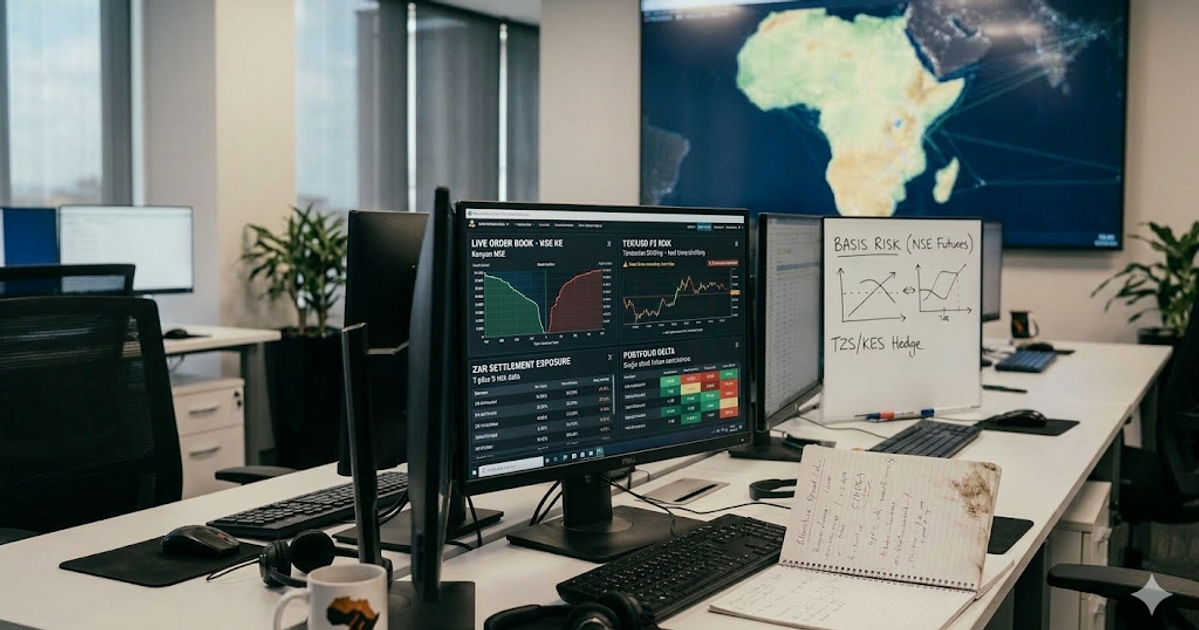
Try market making on the Dar es Salaam Stock Exchange. No options. No futures. No swaps. If you accumulate a position you don't want, you can't buy a put to protect it. You can't short a futures contract to flatten your delta. You sit with it, manage it with your quotes, and work your way out.
Now compare that to the Nairobi Securities Exchange, which already lists single-stock futures and is preparing to launch options on those futures. Or the JSE in Johannesburg, where you have a full derivatives suite — equity options, index futures, currency derivatives, the works.
This is the reality of pan-African market making. The risk management playbook changes at every border crossing. And if you're copying a framework designed for the NYSE or LSE, you're going to have a bad time.
At Shabba Financial, we build algorithmic market making systems for African exchanges. Risk management isn't a chapter in our operations manual — it's the thing that determines whether we survive the week. Here's how we actually think about it.
The Problem No Textbook Covers
Most risk management literature assumes you have access to hedging instruments. The classic market maker framework goes something like: quote both sides, accumulate inventory, hedge with derivatives, collect the spread. Clean and elegant.
On the DSE, step three doesn't exist.
So what do you actually do? You adapt. And the adaptations, honestly, are where the interesting work happens.
Inventory Skewing
Tighten the ask, widen the bid so the market naturally takes inventory off your hands. The skill is calibrating aggression without signalling your hand.
Cross-Listed Stocks
Several East African companies trade on multiple exchanges. Long on the DSE? Sell on the NSE. Different books, different settlement cycles — same underlying exposure.
Correlated Assets
FX pairs, related equities, ETFs on exchanges that offer them. Correlations aren't as stable as you'd like — especially under stress — but they reduce portfolio-level risk when single-name hedging isn't available.
Position Limits and Discipline
Hard caps on inventory. Time-based unwinding rules. Automatic quote withdrawal at exposure thresholds. Unglamorous — but in a market without derivatives, the ability to say "no more" is itself a risk management tool.
Why the NSE Futures Market Changes the Game
The Nairobi Securities Exchange's move into derivatives is significant for anyone operating across East Africa. Single-stock futures already trade, and the planned introduction of options on futures will open up strategies that simply aren't possible today.
NSE Derivatives · What it unlocks for market makers
Delta hedging, cross-exchange protection, and tradeable volatility
On the NSE you'll be able to quote equities while managing directional exposure through futures — a fundamentally different risk profile than the DSE. A position on the DSE in a cross-listed name could be hedged with a futures contract on the NSE. And once options are available, market makers who are naturally short gamma can buy protection, changing the entire risk calculus.
This isn't just a Nairobi story. As one exchange in the region builds out its derivatives infrastructure, it creates hedging possibilities for market makers across neighbouring exchanges. The spillover effects matter.
The absence of hedging tools is a constraint, but also a discipline. When you can't hedge, you're forced to be more thoughtful about every position you take.
What We Actually Monitor (And Why)
Risk dashboards are easy to build. Knowing what to put on them is harder. Here's what we've found actually matters when you're running market making algorithms on African exchanges.
| Signal | Why it matters |
|---|---|
| Inventory age, not just size | A 10,000-share position held for two hours is very different from one accumulated 30 seconds ago. In illiquid markets, duration is a risk factor. We track time-weighted inventory and escalate alerts based on how long we've held, not just notional value. |
| Effective vs. quoted spread | You can quote a 2% spread all day, but if you're consistently getting picked off on one side, your effective spread might be 0.5% or negative. Fill asymmetry tells you whether informed traders are eating your lunch before any P&L report would. |
| Local currency volatility | On exchanges denominated in TZS, KES, or ZAR, your USD-denominated returns can swing wildly on FX moves alone. A profitable day in local currency can turn into a loss once you account for currency. We monitor FX as a first-class risk factor. |
| Settlement and counterparty exposure | African markets commonly settle T+2/3 or longer. You're carrying counterparty risk for days after a trade, during which the market can move significantly. We model unsettled exposure as a distinct risk category. |
Stress Testing Against Markets That Don't Have Much History
Here's a problem: if you want to stress test your models against a "2008-style crash" on the DSE, you don't have great data for it. Some of these exchanges have limited electronic trading history, sparse tick data, and trading volumes that look nothing like developed markets.
Our approach runs backtests against three types of scenarios.
Stress Testing Framework · Three scenario types
Historical analogues, translated scenarios, and synthetic stress
Historical analogues from the local market — election-related volatility, currency devaluation episodes, COVID-era disruptions. Limited data, but the most representative of how these specific markets behave under stress. Translated scenarios from deeper markets — we map events like the March 2020 crash onto African market parameters: lower liquidity, wider spreads, no derivatives. The question isn't "what would the S&P do" but "what would a 30% volatility spike look like when daily volume is $500K?" Synthetic stress scenarios — pure hypotheticals. Connectivity down for 15 minutes. Exchange halts a stock we're making markets in. A currency peg breaks overnight. These are the scenarios that keep us honest.
We haven't yet traded live through a true market crisis. We're transparent about that. What we have done is build systems that are designed to degrade gracefully — automatic position reduction, quote withdrawal, and conservative re-engagement protocols — so that when the stress comes, the response is mechanical, not emotional.
The Regulatory Patchwork
Pan-African market making means operating under multiple regulatory frameworks simultaneously. The CMSA in Tanzania, the CMA in Kenya, the FSCA in South Africa — each has its own rules on market making obligations, capital requirements, and reporting standards.
| Reality | Practical implication |
|---|---|
| Capital adequacy differs | What satisfies the CMSA may not satisfy the CMA. The FSCA has its own framework closer to Basel standards. We maintain separate capital buffers per jurisdiction. |
| Reporting cadences vary | Some regulators want daily reports, others want real-time. Building compliance infrastructure that serves multiple regulators simultaneously is a non-trivial engineering problem. |
| Quoting obligations differ | Some exchanges mandate continuous quoting; others allow flexibility. Your risk system needs to account for the fact that you may not be able to simply withdraw quotes when you want to. |
Our Technology Choices (And Why They Matter for Risk)
We use the FIX protocol for exchange connectivity — worth mentioning because in some African markets, FIX adoption is still relatively recent. The advantage for risk management is standardisation: every order, execution, and position update flows through a consistent message format, which makes it much easier to build reliable pre-trade and post-trade risk checks.
Our pre-trade risk layer validates every outgoing order against position limits, capital thresholds, price reasonableness checks, and market condition flags. If the validation fails, the order doesn't go out. No exceptions, no overrides at the algorithm level. Manual override requires human authorisation and gets logged separately.
The system runs on redundant infrastructure with separate primary and failover environments. In markets where connectivity can be less reliable, your backup systems aren't a nice-to-have. They're core infrastructure.
Simple risk controls, strictly enforced, beat sophisticated models loosely applied. A hard position limit that never gets overridden is worth more than a VaR model that gets ignored when it's inconvenient.
What We've Learned So Far
We're a young firm operating in markets that are themselves still maturing. We don't pretend to have all the answers. But a few convictions have hardened through experience.
Simple controls, strictly enforced
A hard position limit that never gets overridden is worth more than a VaR model that gets ignored when it's inconvenient.
African markets aren't broken
They have different microstructure, different participant behaviour, different liquidity patterns. Risk frameworks need to be built for these markets — not adapted from somewhere else.
No hedging is a discipline
When you can't hedge, you're forced to be more thoughtful about every position you take. That produces more rigorous risk culture than environments where you can always "just buy a put."
Infrastructure is a risk factor
Exchange technology, internet connectivity, power supply — all variable. Operational risk management here isn't a compliance checkbox. It's survival.
The opportunity is enormous. African capital markets are growing. Exchanges are modernising. Derivatives are coming. The firms that build serious risk management frameworks now — frameworks designed for the current constraints while being ready for the tools that are coming — will be the ones that scale.
This article reflects the views of the Shabba Financial risk and technology team. We're building algorithmic market making infrastructure for African capital markets. If you're working in this space — whether as an exchange, regulator, broker, or fellow market maker — we'd like to hear from you.